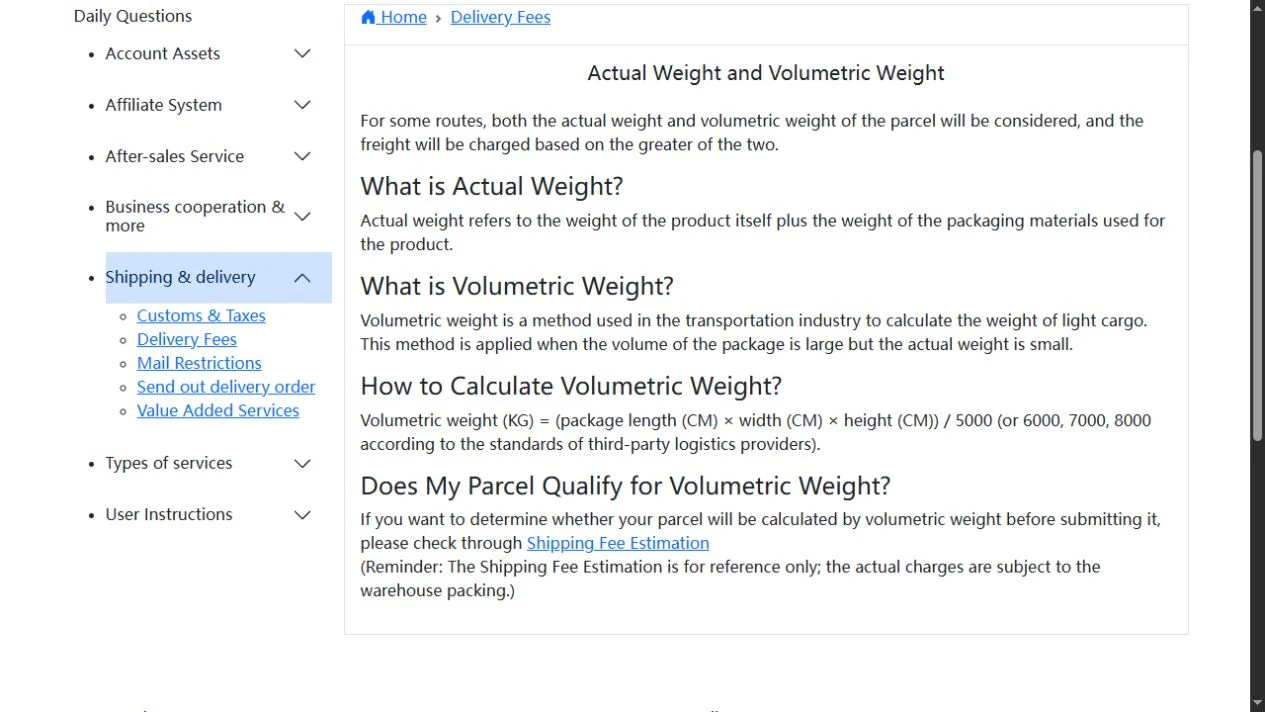
A Joyagoo shipping calculator needs the parcel you plan to send, not just the prices in your shopping list. Start with destination, contents, packed dimensions and actual weight. Then use the selected line's rules and current rate to turn those inputs into an estimate.
A worked weight comparison
Consider this hypothetical package, not a paid shipment or quoted service:
| Input | Illustrative value |
|---|---|
| Packed length × width × height | 45 × 32 × 25 cm |
| Assumed volumetric divisor | 6000 |
| Actual packed weight | 5.4 kg |
| Volumetric calculation | 45 × 32 × 25 ÷ 6000 = 6 kg |
For a service that compares these values and uses the larger, the starting basis is 6 kg. The service's rounding, minimums and other terms may still affect what is charged. The assumed divisor is not a universal Joyagoo rule.
What if the box becomes shorter?
If the same hypothetical package is 22 cm high, its volumetric weight becomes 5.28 kg. Against an unchanged actual weight of 5.4 kg, actual weight would now be larger. Reducing dimensions further would not automatically lower that greater-of basis below 5.4 kg.
This arithmetic does not promise a saving. Confirm the real packed weight, protection, line eligibility and rate before comparing payable totals.
What the calculation does not include
It does not establish a delivery date, customs outcome, insurance cover or a live freight price. A formula explains a weight basis; a quote needs the chosen service and current terms. Keep item purchase costs separate from international transport.
Explore bags and accessories in the catalog without assuming that a small-looking product always forms a small parcel. Packaging and protection may be important parts of its dimensions.
Use shipping cost guidance to compare eligible services on equal inputs. Finish QC and any return decision before finalising contents. The order guide explains when the estimate becomes a parcel decision rather than an early planning number.